

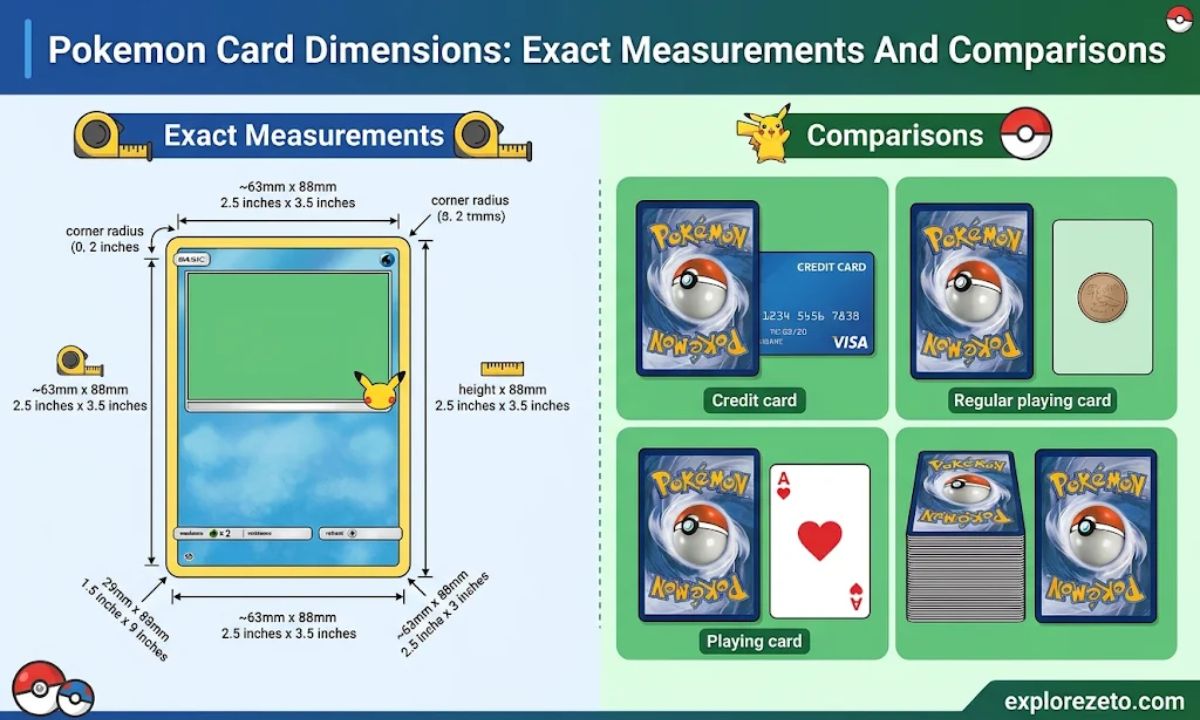
A standard Pokémon card measures 63 mm wide by 88 mm tall, which equals 2.5 inches by 3.5 inches. That size has stayed the same for decades, across English, Japanese, and most other print runs. Whether you are buying sleeves, designing a custom card, or checking a card you suspect is fake, the exact numbers matter.
This guide covers every measurement you are likely to need, including millimeters, inches, pixels, bleed, thickness, weight, and sleeve sizes. You will also find visual comparisons and a practical checklist for spotting fakes.
Quick Measurements for Pokémon Card
Here are the core numbers in one place.
| Measurement | Metric | Imperial |
| Width | 63 mm | 2.5 in |
| Height | 88 mm | 3.5 in |
| Thickness | About 0.3 mm | About 0.012 in |
| Weight | About 1.7 g | About 0.06 oz |
| Corner radius | About 3 mm | About 0.12 in |
| Aspect ratio | 5:7 | 5:7 |
A standard Pokémon card is 63 mm by 88 mm (2.5 by 3.5 inches), about 0.3 mm thick, and weighs roughly 1.7 grams.
These values describe regular cards from the Pokémon Trading Card Game. Small manufacturing tolerances exist, so a genuine card may differ from these figures by a fraction of a millimeter.
Exact Pokémon Card Dimensions: The Full Breakdown
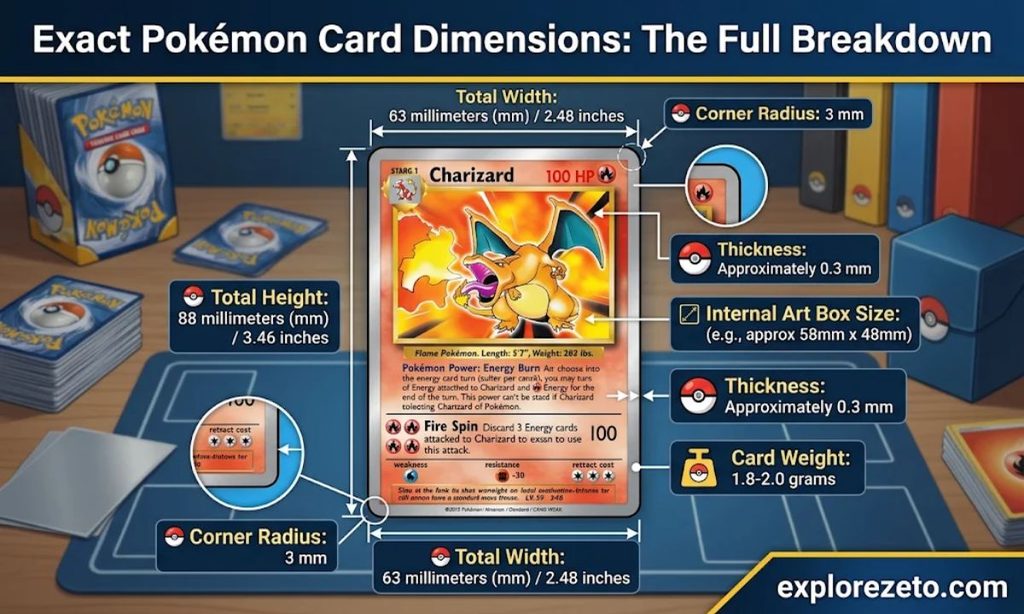
Each measurement tells you something different about a card.
Width and height. The card is 63 mm wide and 88 mm tall in portrait orientation. In inches, that is 2.48 by 3.46, which most people round to 2.5 by 3.5.
Thickness. A single Pokémon card is about 0.3 mm thick. Card stock, coating, and the layered paper core all affect this number. Holographic and full art cards can feel slightly stiffer, yet their thickness stays very close to a regular card.
Weight. Most modern Pokémon cards weigh between 1.6 and 1.8 grams. Weight is a useful check because counterfeit cards often use different paper stock.
Corner radius. The corners are rounded at about 3 mm. This detail is hard for cheap fakes to replicate consistently.
Aspect ratio. The ratio is 5:7. This ratio matters for designers because any custom artwork must match it to avoid stretching.
A quick fact worth remembering: the Pokémon Trading Card Game uses the same 5:7 card ratio as most major trading card games.
Pokemon Card Dimensions in CM, MM, and Inches: All Formats
Different regions and tools use different units. This table converts the standard size into every common format.
| Unit | Width | Height |
| Millimeters (mm) | 63 | 88 |
| Centimeters (cm) | 6.3 | 8.8 |
| Inches (in) | 2.5 | 3.5 |
| Points (pt) | 178.6 | 249.4 |
| Picas | 14.9 | 20.8 |
A Pokémon card is 6.3 cm wide and 8.8 cm tall.
Printers in the United States usually work in inches. European and Asian printers generally prefer millimeters. If you order custom sleeves or display cases, always confirm which unit the seller uses before you buy.
Pokemon Cards Dimensions in Pixels and Digital Use
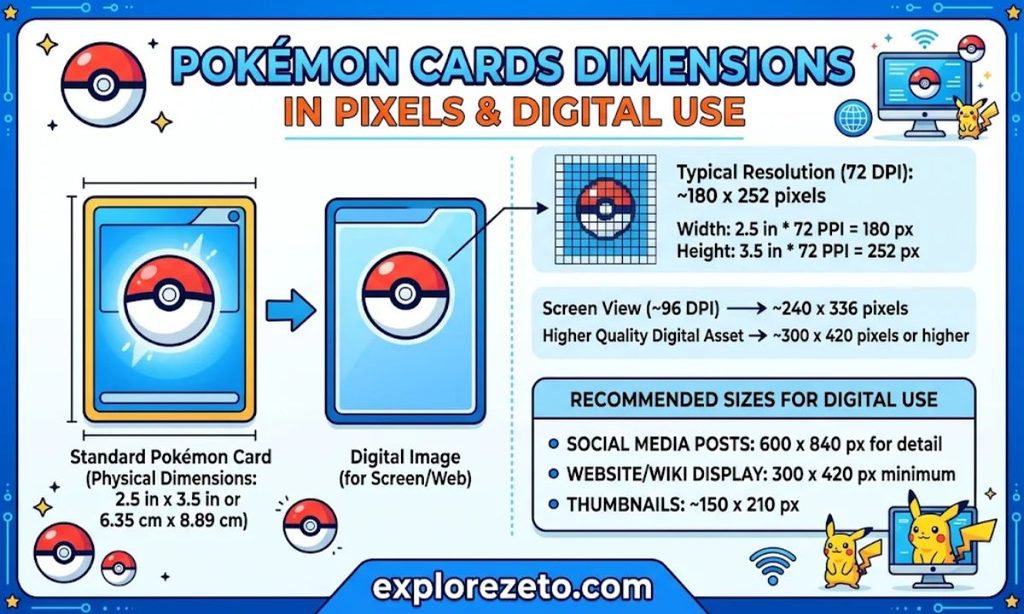
Pixels depend on resolution. A card has no fixed pixel size until you choose how many pixels per inch you want. The formula is simple: multiply the inch measurement by the pixels per inch (PPI).
Pokemon Cards Dimensions in Pixels by Resolution
| Resolution | Pixel Size (W x H) | Best Use |
| 72 PPI | 180 x 252 | Small web thumbnails |
| 96 PPI | 240 x 336 | Standard screen display |
| 150 PPI | 375 x 525 | Draft prints and previews |
| 300 PPI | 750 x 1050 | Professional printing |
| 600 PPI | 1500 x 2100 | High detail scans and archival |
A Pokémon card at 300 PPI measures 750 by 1050 pixels, which is the standard resolution for print quality.
For websites, a card image at 480 by 672 pixels looks sharp on most screens while keeping file sizes manageable. For deck builders or app mockups, keep the 5:7 ratio so the image never distorts.
Print Bleed Size
Bleed is extra artwork that extends past the cut line so no white edge appears after trimming. Most printers ask for 3 mm of bleed on every side.
- Trim size: 63 x 88 mm
- Bleed size with 3 mm margin: 69 x 94 mm
- Safe zone, 3 mm inside the trim: 57 x 82 mm
A Pokémon card with a standard 3 mm bleed measures 69 mm by 94 mm.
Keep names, attack text, and important symbols inside the safe zone. Anything outside it risks being cut off during trimming.
Pokemon Card Dimensions for Procreate
Procreate users should create a new canvas using custom dimensions. A reliable setup looks like this:
- Open Procreate and tap the plus icon.
- Choose Custom Canvas.
- Set the width to 63 mm and the height to 88 mm.
- Set the DPI to 300.
- Confirm that the canvas reads about 744 by 1039 pixels.
Many artists prefer a clean 750 by 1050 pixel canvas at 300 DPI instead. That version is easy to scale and matches the 5:7 ratio exactly. If you plan to print, build your canvas at 69 by 94 mm to include bleed, then mark the trim line on a separate layer.
All Pokémon Card Sizes: Standard, Jumbo, and Variants
Not every Pokémon card follows the standard size. Collectors should know the main variants.
Standard Card
The standard Pokémon card size is 63 mm by 88 mm. Nearly every card pulled from booster packs, theme decks, and Elite Trainer Boxes uses this size. Tournament play also requires this size.
All Pokémon Card Size Variants
| Card Type | Approximate Size | Notes |
| Standard | 63 x 88 mm (2.5 x 3.5 in) | Used in packs, decks, and tournaments |
| Jumbo | About 165 x 235 mm (6.5 x 9.5 in) | Oversized promo cards, not legal for play |
| Mini | About 44 x 63 mm (1.7 x 2.5 in) | Found in tins and collector sets |
| Giant or display cards | Varies by release | Often sold in special boxes |
Jumbo Pokémon cards are roughly 6.5 by 9.5 inches, which is about four times the area of a standard card.
Jumbo cards are popular with display collectors because the artwork looks stunning at that size. They are not allowed in sanctioned tournaments. Mini cards behave the same way, since they do not match the legal card size.
Exact jumbo and mini measurements can vary slightly by product line, so check the product listing before ordering matching storage.
How Big Is a Pokémon Card Really? Visual Comparisons
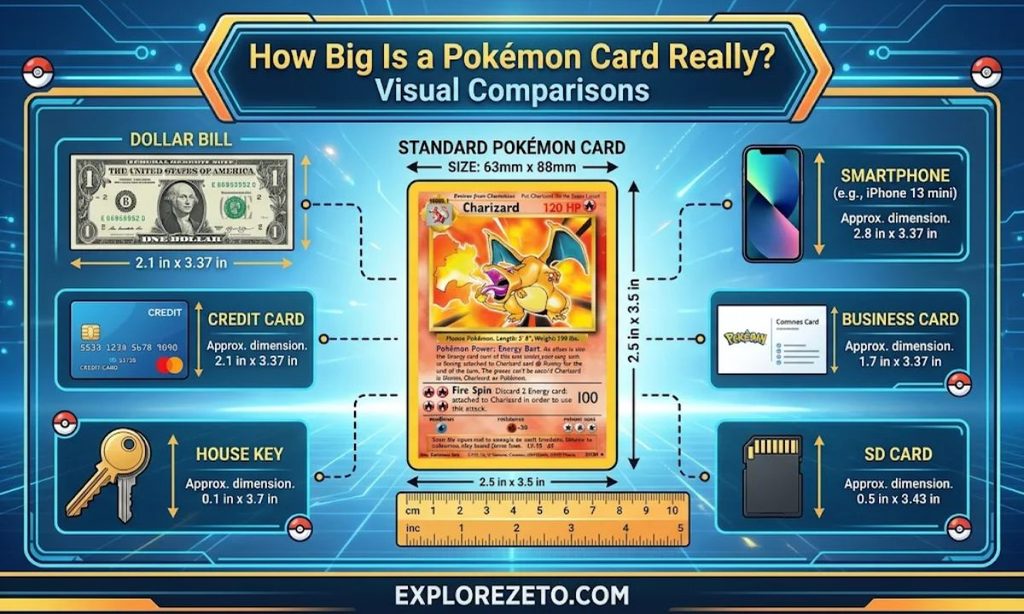
Numbers can feel abstract. These everyday comparisons make the size easier to picture.
A Standard Credit Card
A credit card measures 85.6 by 54 mm. A Pokémon card is about 2.4 mm narrower in length terms but much taller, and it is roughly 10 mm wider than the credit card is tall. Put them side by side and the Pokémon card is clearly the larger one, while the credit card is wider than it is tall. A Pokémon card is taller than a credit card by about 2 mm and is much thicker, at 0.3 mm versus 0.76 mm for a credit card, which is the reverse: the credit card is thicker.
To keep it simple: a credit card is thicker and more rigid, but a Pokémon card has more surface area.
A US Dollar Bill
A US dollar bill measures about 156 by 66 mm. A Pokémon card is shorter than the bill by roughly 68 mm in length, though the card is slightly narrower than the bill’s width when you rotate it. Laid flat, you can fit two Pokémon cards side by side across the length of a dollar bill with room to spare.
A Standard Smartphone
Most modern smartphones are about 147 by 71 mm. A Pokémon card is slightly shorter and narrower than a typical phone. Place a card on your phone screen and it covers most of the display height. This comparison is handy when you check a listing photo on your phone.
A Playing Card
A standard poker playing card measures about 63.5 by 88.9 mm. A Pokémon card is almost the same size as a poker playing card, differing by less than 1 mm in each direction. That is why many collectors use playing card sleeves in a pinch, though a snug fit is not guaranteed.
A Post-It Note
A classic Post-it Note is 76 by 76 mm. A Pokémon card is narrower than a Post-it but 12 mm taller. If you hold one against the other, the card sticks out above the note and leaves a margin on both sides.
Japanese vs International Pokémon Cards: Same Size
Japanese Pokémon cards and international Pokémon cards share the same 63 mm by 88 mm dimensions. The Pokémon Company uses one global standard, so a Japanese card fits in an English deck box and the reverse.
There are small differences worth knowing:
- Print finish: Japanese cards often have a glossier surface and sharper print texture.
- Card back: The back design is the same for most releases, but some promo cards differ.
- Text and symbols: Language, set symbols, and regulation marks change by region.
None of these differences change the physical size. If a card claims to be Japanese but measures noticeably different from 63 by 88 mm, treat it with suspicion.
One more point for Yu-Gi-Oh fans: Japanese Yu-Gi-Oh cards are smaller than Pokémon cards, so do not assume all Japanese trading cards share one size.
Pokemon Card Dimensions for Sleeves and Storage
Sleeve and storage sizes are slightly larger than the card itself. A snug fit protects the card from dust, moisture, and edge wear.
Sleeve Sizes by Type
| Sleeve Type | Typical Size | Use |
| Inner sleeve (perfect fit) | About 62 x 89 mm | First layer, goes inside a standard sleeve |
| Standard outer sleeve | About 66 x 91 mm | Everyday deck protection |
| Japanese small sleeve | About 62 x 89 mm | Fits Japanese cards snugly |
| Penny sleeve | About 67 x 92 mm | Budget storage for bulk and singles |
A standard Pokémon card sleeve is about 66 by 91 mm, which leaves roughly 1.5 mm of space around the card.
Many players use a double sleeve method. They slide the card into a perfect fit inner sleeve, then place it inside a standard outer sleeve. This setup cuts down on edge wear and keeps the card from sliding around during shuffling.
Toploader Sizes
A standard toploader for Pokémon cards measures about 3 by 4 inches (76 by 102 mm) on the outside. The inner opening is made for a card with a regular sleeve, so most collectors slip a penny sleeve on first.
- 35pt toploader: Fits a standard card with a sleeve. This is the most common choice.
- 55pt toploader: Fits thicker cards or cards with an extra layer.
- 75pt and 130pt toploaders: Made for thicker memorabilia cards and special cases.
A 35pt toploader is the correct choice for a standard Pokémon card because the 0.3 mm card plus a sleeve fits inside the 35 point thickness.
If you plan to submit cards for grading, check the grading company’s own rules, since they may prefer semi-rigid holders instead of toploaders.
Read More: How Big Is 69 Inches? 11 Everyday Things That Prove the Point
Pokemon Card vs Other Trading Cards
Not all trading cards share the same footprint. This comparison shows how Pokémon cards stack up.
| Trading Card | Size (mm) | Size (in) |
| Pokémon | 63 x 88 | 2.5 x 3.5 |
| Magic: The Gathering | 63 x 88 | 2.5 x 3.5 |
| Yu-Gi-Oh! | 59 x 86 | 2.3 x 3.4 |
| Poker playing card | 63.5 x 88.9 | 2.5 x 3.5 |
| Standard tarot card | 70 x 120 | 2.8 x 4.7 |
| Baseball card | 63.5 x 88.9 | 2.5 x 3.5 |
Pokémon and Magic: The Gathering cards are the same size, 63 mm by 88 mm. That means sleeves for one will generally fit the other.
Yu-Gi-Oh! cards are slightly smaller. A standard Pokémon sleeve will fit a Yu-Gi-Oh! card loosely, but the reverse will not work because Yu-Gi-Oh! sleeves are too small for a Pokémon card.
How to Spot Fake Pokémon Cards Using Dimensions
Counterfeit cards have improved, but physical measurements still reveal many fakes. Use these five checks together rather than relying on any single one.
Width and Height
Measure the card with a ruler or caliper. A real card should land within about 0.5 mm of 63 by 88 mm. Fakes cut in bulk often come out a millimeter or two off. Compare the suspect card to one you know is real from the same era.
Thickness
A genuine card is about 0.3 mm thick. Stack ten real cards and the pile should measure around 3 mm. A suspect card that feels thin like office paper or thick like cardboard deserves a closer look.
Weight
A real card weighs about 1.7 grams. Use a jeweler’s scale that reads to 0.01 grams. A genuine Pokémon card typically weighs between 1.6 and 1.8 grams, and a noticeably lighter or heavier card may be counterfeit. Weight can vary slightly by era, so compare against a known real card from the same set.
The Light Test
Shine a phone flashlight through the card in a dark room. Real Pokémon cards have a layered core, often with a dark or bluish middle layer, that blocks most light. Fakes often glow evenly because they lack that layer. The light test is one of the fastest checks you can do at home.
Corner Radius
Look at the corners. Real cards have a consistent rounded corner of about 3 mm. Fakes often have sharper, uneven, or overly round corners. Place the suspect card on top of a real one and check whether the corners line up exactly.
No single test is definitive. Combine dimensions, weight, the light test, print quality, and font accuracy before you decide.
How to Measure a Pokémon Card Without Calipers
You do not need special tools to check a card. Try these simple methods.
- Use a ruler. Place the card flat against a metric ruler. Read the width and height to the nearest half millimeter.
- Compare with a known card. Put a real card from your collection on top of the suspect one. Check whether the edges match.
- Use a stack. Measure ten cards in a stack with a ruler. Divide the total height by ten to estimate thickness.
- Use a credit card. A credit card is 85.6 mm long. Hold a Pokémon card against it, and you can estimate the 88 mm height by seeing that the Pokémon card is slightly taller.
- Use a phone app. Many free ruler apps let you place a card on the screen and measure it. Accuracy varies, so treat the result as a rough guide.
The easiest way to measure a Pokémon card at home is to lay it on a metric ruler and confirm it reads 63 mm wide and 88 mm tall.
For more precise work, a digital caliper costs very little and reads to 0.01 mm.
FAQs
What size is a standard Pokémon card?
A standard Pokémon card is 63 mm by 88 mm, or 2.5 by 3.5 inches. This is the size used in booster packs, decks, and tournaments.
How thick is a Pokémon card?
A Pokémon card is about 0.3 mm thick, or roughly 0.012 inches. Slight differences exist between printings and card types.
How much does a Pokémon card weigh?
A standard Pokémon card weighs about 1.7 grams. Genuine cards usually fall between 1.6 and 1.8 grams.
Are Japanese Pokémon cards the same size as English cards?
Yes. Japanese and English Pokémon cards both measure 63 mm by 88 mm, so they fit the same sleeves and storage.
What is the pixel size of a Pokémon card?
At 300 PPI, a Pokémon card measures 750 by 1050 pixels. At 96 PPI for screens, it measures 240 by 336 pixels.
What is the bleed size for a Pokémon card?
With a 3 mm bleed on each side, the print file should measure 69 mm by 94 mm. The final trimmed card is 63 mm by 88 mm.
How big is a jumbo Pokémon card?
A jumbo Pokémon card is about 6.5 by 9.5 inches, which is roughly 165 by 235 mm. Jumbo cards are not legal for tournament play.
Final Thought
Pokémon card dimensions are simple once you know the key numbers. The standard size is 63 mm by 88 mm, with a thickness near 0.3 mm and a weight near 1.7 grams. Those values hold for Japanese and international cards, and they match Magic: The Gathering cards almost exactly.
Use the pixel and bleed tables if you design custom cards, and use the sleeve and toploader tables when you protect your collection. If you worry about authenticity, combine the width, thickness, weight, light, and corner checks for a stronger result.

Liam Carter is a measurement focused writer and researcher at ExploreZeto.com. He creates clear, practical content covering measurement units, conversions, calculations, tools, and everyday applications. Liam focuses on careful research, straightforward explanations, and useful examples, helping readers understand measurement concepts with greater clarity and confidence.