

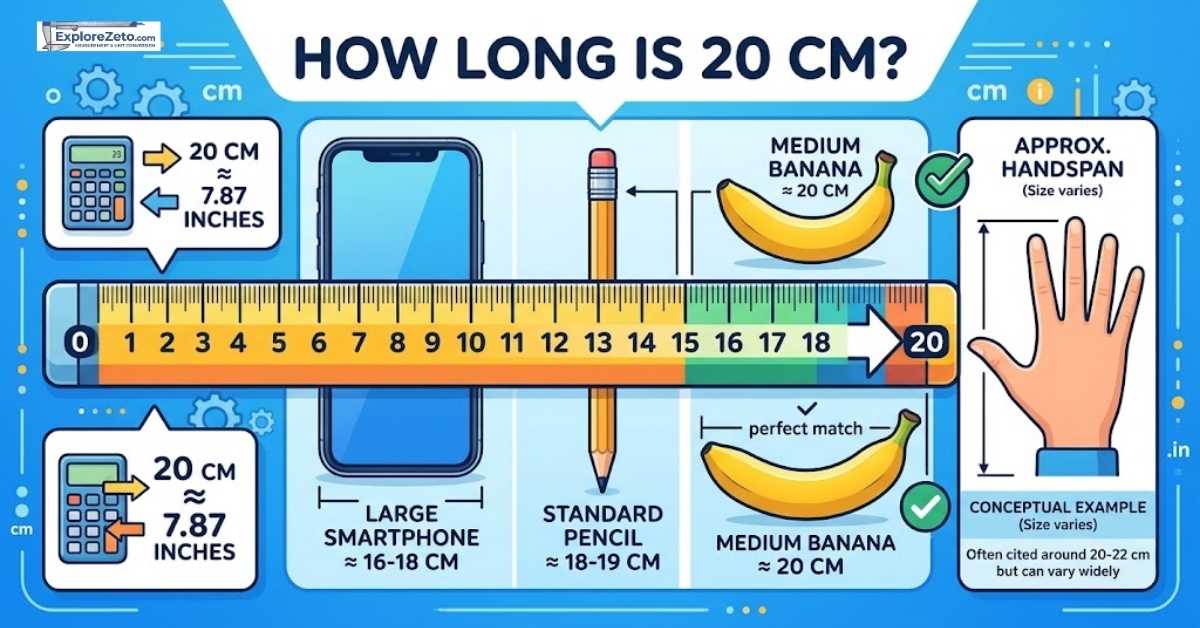
Have you ever wondered, how long is 20 cm when you see it on a product page? You’re not alone! Many people find it hard to picture measurements without a ruler. The good news is that 20 cm is easy to understand when you compare it with everyday objects. It equals 7.87 inches, 200 millimeters, and 0.2 meters. But what does this length actually look like in real life? A few familiar items can help you visualize it quickly.
In this guide, you’ll discover how long is 20 cm through 17 everyday object comparisons. You’ll also learn simple conversions, measuring tips, and useful size comparisons. Whether you’re shopping online, working on a craft project, or checking product dimensions, this guide makes things easier. By the end, you’ll know exactly how to picture 20 cm without guessing or reaching for a measuring tape.
In This Guide:
- 20 CM By Every Unit You Could Ever Need
- Twelve Things Near You Right Now That Prove the Point
- Left Your Ruler Somewhere? Try These Instead
- How to Measure 20 cm Accurately
- 20 cm vs 8 Inches
- The 20 cm Pizza Angle Most People Miss
- FAQs
- One Last Thing
20 CM By Every Unit You Could Ever Need
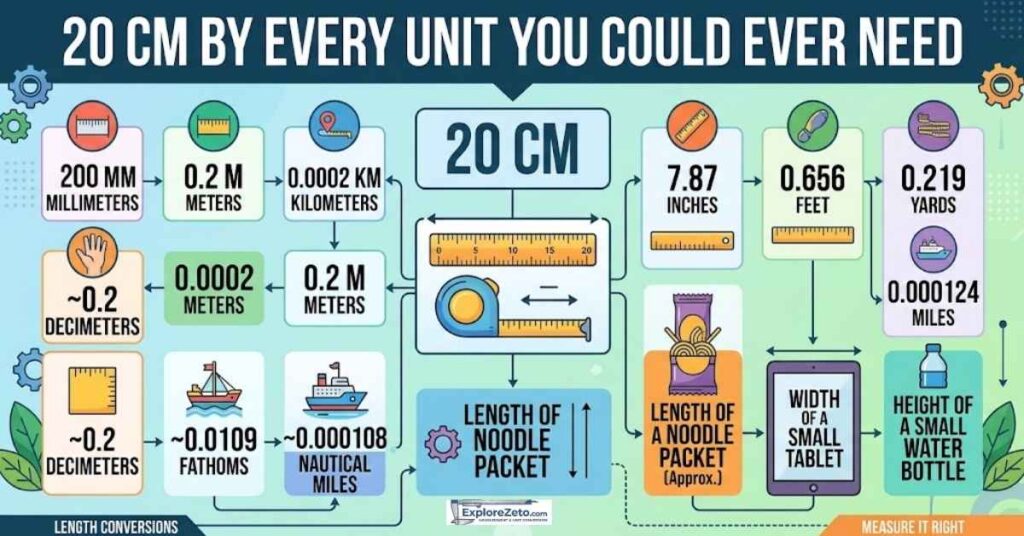
Understanding 20 cm becomes easier when you know its equivalent measurements. Whether you’re shopping online, working on a craft project, or checking an item’s dimensions, these conversions help you visualize the length.
20 cm Conversion Chart
| Unit | Equivalent |
| Centimeters | 20 cm |
| Inches | 7.874 in |
| Feet | 0.656 ft |
| Millimeters | 200 mm |
| Meters | 0.2 m |
| Yards | 0.219 yd |
| Pixels at 96 DPI | Approximately 756 px |
| Pixels at 300 DPI | Approximately 2,362 px |
Pixel values depend on the resolution used for the conversion. For everyday measurements, inches, millimeters, and meters are usually more practical.
20 cm to Inches
To convert 20 cm to inches, divide the measurement by 2.54 because one inch equals exactly 2.54 centimeters.
20 ÷ 2.54 = 7.874 inches.
You can round this result to 7.87 inches for everyday use. If you need a precise measurement for engineering, construction, or fitting parts together, keep more decimal places.
20 cm in Feet
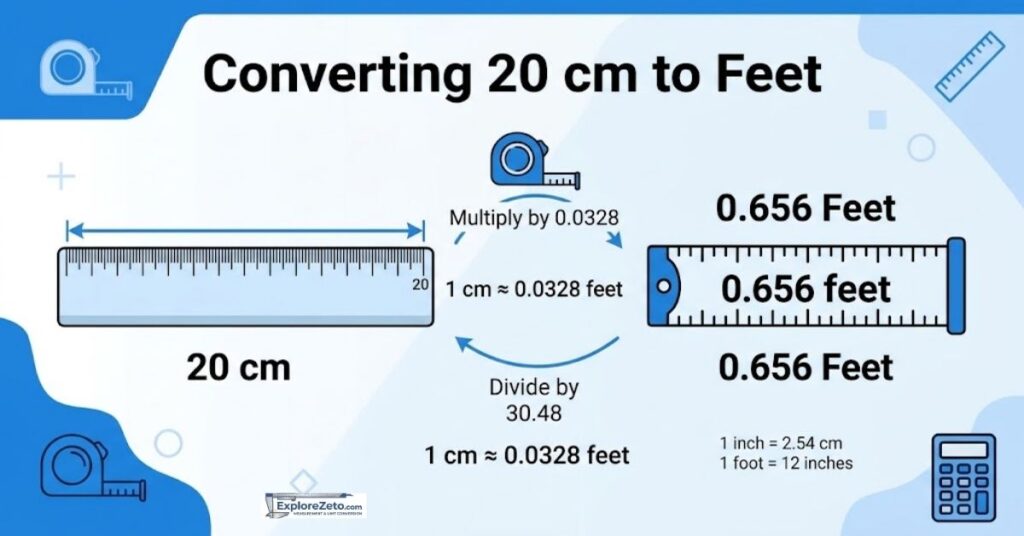
To calculate 20 cm in feet, divide the measurement by 30.48, the number of centimeters in one foot.
20 ÷ 30.48 = 0.6562 feet.
Therefore, 20 cm is approximately 0.656 feet. Since this is less than one foot, inches provide a more convenient way to picture the length.
20 cm to mm
Converting 20 cm to mm is straightforward because one centimeter contains 10 millimeters.
20 × 10 = 200 mm.
This means 20 cm and 200 mm describe exactly the same length. Millimeters are particularly useful when measuring small parts, jewelry, stationery, and craft materials.
20cm to Meter
To convert centimeters into meters, divide the measurement by 100.
20 ÷ 100 = 0.2 meters.
So, 20 cm equals 0.2 meters, or one-fifth of a meter. This conversion is helpful when working with fabric, furniture dimensions, room measurements, and other metric specifications.
How Many Inches Is 20 mm?
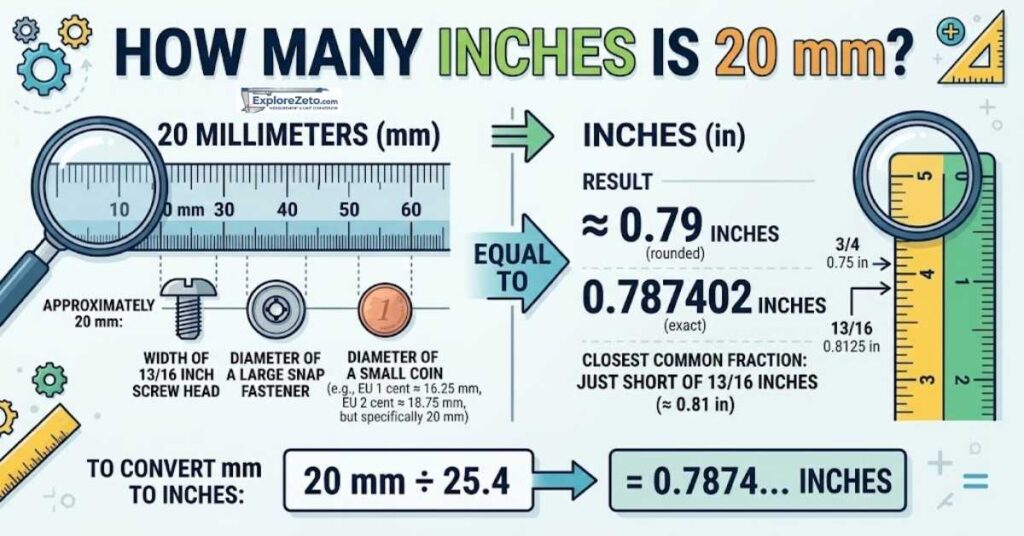
Twenty millimeters is much shorter than 20 centimeters. Since 20 mm equals 2 cm, dividing 20 by 25.4 gives the measurement in inches.
20 ÷ 25.4 = 0.787 inches.
Therefore, 20 mm is approximately 0.79 inches, while 20 cm is approximately 7.87 inches. Always check whether a product specification uses millimeters or centimeters because confusing the two can lead to a significant measuring error.
30 cm to Inches
Thirty centimeters equals approximately 11.81 inches.
To calculate the conversion, divide 30 by 2.54. The result is about 11.811 inches, which is close to one foot but slightly shorter than 12 inches.
This comparison helps you understand how 30 cm differs from 20 cm. A 30 cm measurement is 10 cm longer, making it half as long again as a 20 cm measurement.
15 cm to Inches
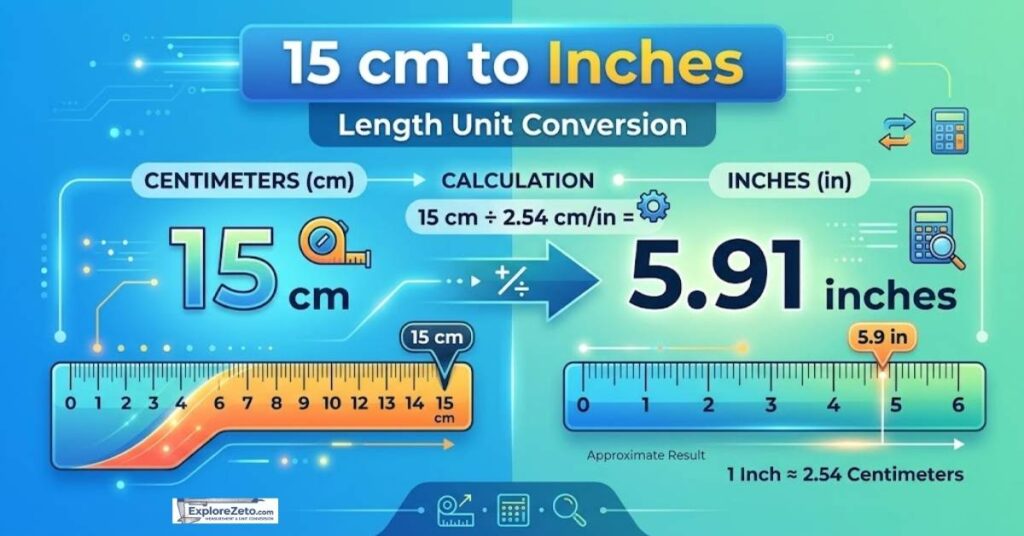
Fifteen centimeters equals approximately 5.91 inches.
Divide 15 by 2.54 to get the result. This length is a little shorter than 6 inches and is useful when measuring compact objects, small notebooks, and craft materials.
Compared with 20 cm, a 15 cm object is 5 cm shorter. Knowing both measurements makes it easier to estimate dimensions without using a calculator every time.
25 cm to Inches
Twenty-five centimeters equals approximately 9.84 inches.
The calculation is 25 ÷ 2.54, which gives about 9.8425 inches. This is just under 10 inches and is a useful reference for slightly longer objects.
A 25 cm measurement is 5 cm longer than 20 cm. If you can picture a 20 cm object, imagine adding another 5 cm to understand the difference.
Seventeen Things Near You Right Now That Prove the Point
Numbers alone can be difficult to visualize. Familiar objects make measurements easier to understand because you can compare their sizes with something you already know.
The following 17 examples include everyday items that measure approximately 20 cm or come close to it. Some are near-exact matches, while others are slightly longer or shorter. Actual dimensions vary by product and manufacturer.
Read More:How Long Is 8 Inches? Real Meaning With Everyday Examples
A Folded Newspaper

A broadsheet newspaper can measure approximately 38 to 40 cm across when fully open. Folding it in half brings each side to around 19 to 20 cm.
This makes a folded newspaper a useful visual reference for 20 cm. However, newspaper dimensions vary, so use this comparison for estimating rather than precision measuring.
A Standard Unsharpened HB Pencil
A new HB pencil often measures around 17.5 to 19 cm, although some models are longer.
That makes a fresh pencil a close reference for 20 cm. Compare the pencil with your target length and imagine adding approximately 1 to 2.5 cm.
A sharpened pencil may be shorter, so check its actual length before relying on it.
A Men’s Dress Shoe

A men’s UK size 8 dress shoe is generally longer than 20 cm on the outside. The exact length depends on the shoe’s shape and manufacturer.
Instead of treating a full-size shoe as an exact match, picture 20 cm as a portion of its overall length. A smaller child’s shoe may provide a closer comparison, but shoe sizes do not correspond directly to the shoe’s outside measurement.
A Paperback Novel
Many B-format paperback novels measure approximately 198 mm tall, which is almost exactly 20 cm.
Check the book’s longer edge to get a useful visual comparison. Its shorter edge is generally much smaller, often around 13 cm.
Paperback dimensions vary, but a standard B-format novel can be one of the more practical references for this measurement.
A Wooden Cooking Spoon
Wooden cooking spoons often measure around 25 to 35 cm overall. That means many are longer than 20 cm.
You can still use one to estimate the measurement by identifying a 20 cm section of its handle. Once you compare it with a ruler, the spoon can become a convenient reference in your kitchen.
An 8-Inch Tablet Screen
An 8-inch tablet screen measures approximately 20.32 cm diagonally.
Remember that manufacturers measure screen size from one corner to the opposite corner, not across the screen’s width or height. The tablet’s full body may also be larger than its display.
This makes an 8-inch screen a useful comparison for understanding how close 20 cm is to 8 inches.
A Standard DL Envelope
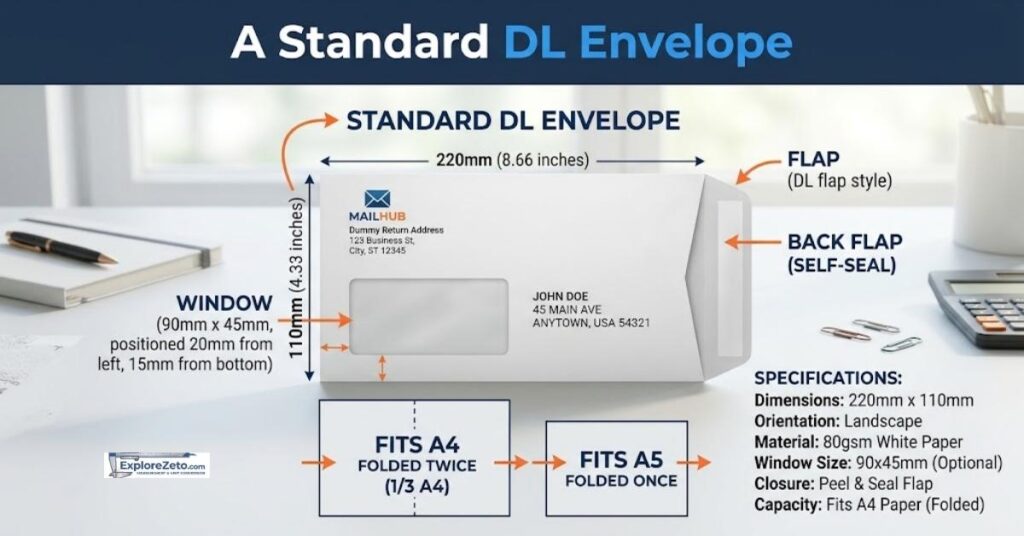
A standard DL envelope measures 110 × 220 mm, or 11 × 22 cm.
Its longer side is therefore 2 cm longer than 20 cm. Imagine removing a small 2 cm section from one end to visualize the difference.
DL envelopes are commonly designed to hold an A4 sheet folded into thirds.
A Newborn Baby’s Foot
A newborn baby’s foot is typically much shorter than 20 cm, often measuring around 7 to 8 cm.
Lining up approximately two and a half foot lengths heel to toe gives you a rough comparison with 20 cm. However, babies vary in size, so this is only a visual estimate.
A Tall 500 ml Can
A typical 500 ml beverage can measures around 16 to 17 cm tall, depending on its design.
It is therefore a few centimeters shorter than 20 cm. Imagine adding roughly 3 to 4 cm above the can to estimate the target length.
This comparison works best with a tall can rather than a shorter, wider container.
A Personal Pizza

A pizza measuring 20 cm across has a diameter of approximately 7.87 inches.
Pizzerias generally measure pizza size from one outer crust edge to the opposite edge. This makes a 20 cm pizza a convenient food-based reference for the measurement.
Keep in mind that the actual edible area depends on the crust and toppings.
A Hardback Children’s Book
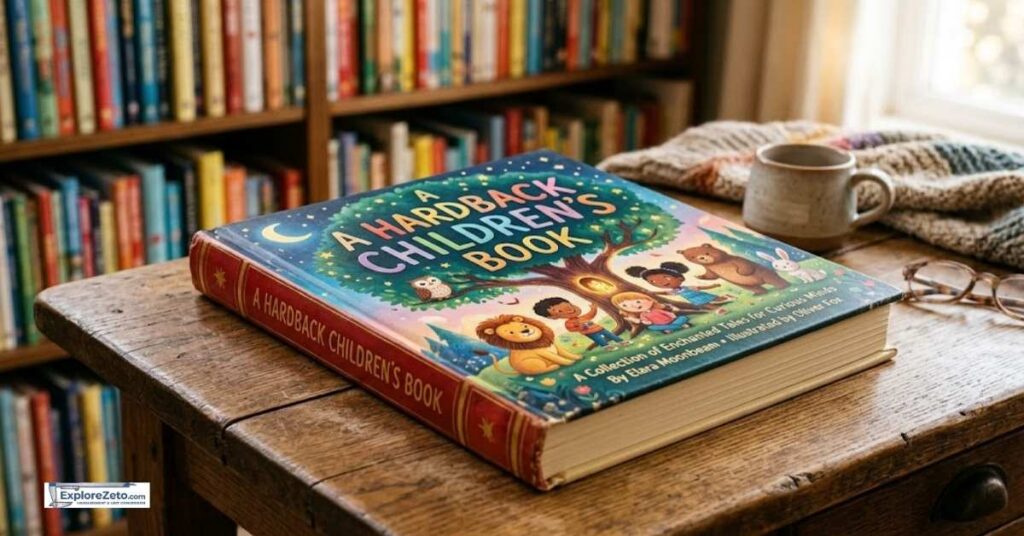
Some compact hardback children’s books measure approximately 20 cm along one edge.
Book dimensions vary considerably, especially for square picture books. Check the actual length of your book before using it as a measuring reference.
If you find one that measures close to 20 cm, it can help children understand this length through an everyday object.
A Standard House Brick
A standard UK house brick measures approximately 215 × 102.5 × 65 mm.
Its longest side is 21.5 cm, making it 1.5 cm longer than 20 cm. Two brick widths placed side by side measure approximately 20.5 cm, which is also a close comparison.
Brick dimensions vary by country and type, so check the specific brick if you need an accurate measurement.
An 8-Inch Chef’s Knife Blade
An 8-inch chef’s knife blade measures approximately 20.32 cm from the heel to the tip. This makes it a close comparison for understanding a 20 cm measurement.
Remember that the blade length is different from the knife’s total length, which also includes the handle. Always check the manufacturer’s specifications when comparing knife dimensions.
A Small Salad Plate

A small salad plate may measure around 20 cm across, depending on its design and manufacturer. Measure straight across the center to compare its diameter with a 20 cm length.
This is a convenient household reference because you can picture the measurement as the width of a plate. However, dinner plates are generally larger, so check the diameter before using one for comparison.
A Medium Ear of Corn
An ear of corn can be close to 20 cm long, although its size varies with the variety and stage of growth. Measure it from one end to the other to check how closely it matches the target length.
Corn provides a simple natural comparison for visualizing 20 cm. If your ear is longer or shorter, use it as an estimate rather than an exact measuring tool.
The Long Edge of A5 Paper
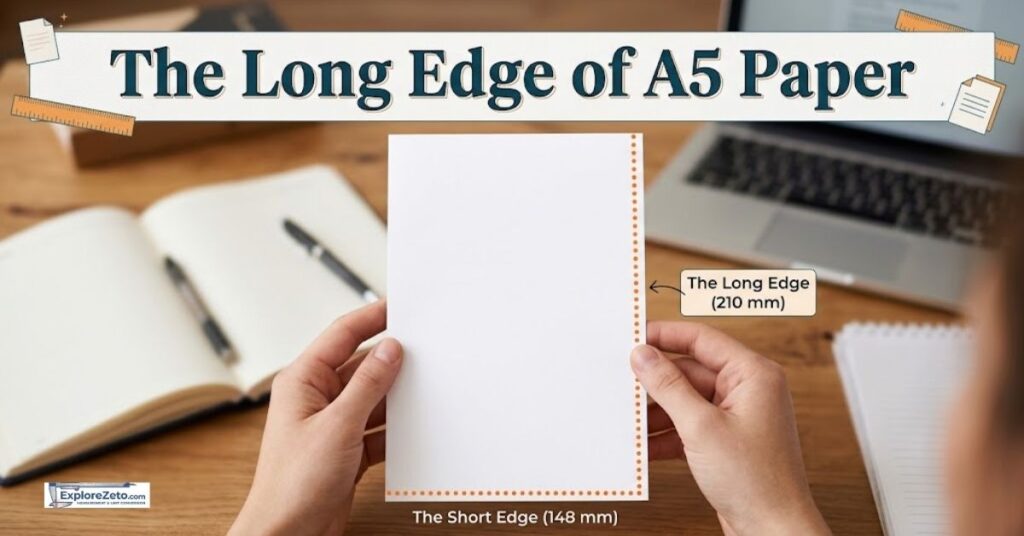
A standard A5 sheet measures 14.8 × 21 cm. Its longer edge is therefore 1 cm longer than 20 cm.
Place the paper horizontally and picture a small 1 cm strip removed from one end. This gives you a quick visual reference for estimating 20 cm without a ruler.
The Short Edge of US Letter Paper
Standard US Letter paper measures 21.59 × 27.94 cm. Its shorter edge is approximately 21.6 cm, making it 1.6 cm longer than 20 cm.
This comparison is especially useful if you live in a country where US Letter paper is commonly used. Remember that its dimensions differ from A4 paper, whose short edge measures 21 cm.
Left Your Ruler Somewhere? Try These Instead
You can estimate 20 cm with everyday objects even when you don’t have a ruler nearby. These methods work well for rough comparisons, although they cannot replace an accurate measuring tool.
- A4 paper: The short side measures 21 cm. It is only 1 cm longer than your target.
- Your hand span: Stretch your thumb and little finger apart. Some adults have a span close to 20 cm, but individual measurements vary.
- Two credit cards: A standard payment card measures approximately 8.56 cm along its longer edge. Two cards placed end to end give about 17.12 cm.
- A new pencil: Many pencils are around 18 to 19 cm long, making them useful for a quick estimate.
- An 8-inch screen: Its diagonal is 20.32 cm, which is very close to 20 cm.
For the most reliable result, measure your hand span or a familiar object once with a ruler. You can then use that known measurement as a reference when estimating similar lengths.
How to Measure 20 cm Accurately
The simplest way to measure 20 cm is to use a metric ruler or measuring tape with centimeter markings.
Place the zero mark at the beginning of the object, then locate the 20 cm mark. Do not automatically start from the physical edge of the ruler because some rulers have a small blank margin before zero.
20 cm Scale
A 20 cm scale or ruler lets you measure this length directly. If your ruler is 30 cm long, the 20 cm mark will be two-thirds of the way along it.
Look for the larger centimeter markings and use the smaller divisions to measure additional millimeters. Twenty centimeters contains 200 millimeters, so each centimeter represents 10 millimeters.
If you’re using a ruler with both metric and imperial markings, the 20 cm point should fall close to 7 7/8 inches. This is useful when comparing measurements given in different units.
Measuring With a Tape Measure
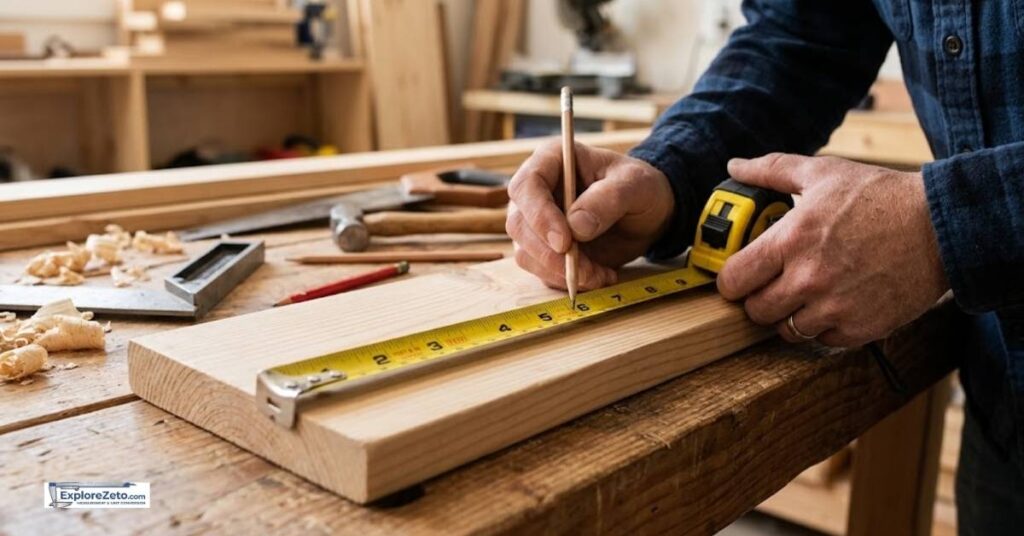
Extend the tape until the zero point lines up with the start of the object. Find the 20 cm marking and check that the tape remains straight.
If your tape measure uses inches, 20 cm falls just before the 8-inch mark. Eight inches equals 20.32 cm, so the difference is small but measurable.
For cutting materials or fitting components, measure twice before making a cut. Small errors can become noticeable when several pieces need to fit together.
20 cm vs 8 Inches
Twenty centimeters and 8 inches are very close, but they are not exactly equal.
Eight inches equals 20.32 cm, making it 0.32 cm, or 3.2 mm, longer than 20 cm.
For everyday tasks such as choosing stationery, comparing household items, or estimating a small object’s size, the difference may not matter much. For construction, manufacturing, and tight-fitting components, use the exact measurement instead of rounding.
The 20 cm Pizza Angle Most People Miss
A 20 cm pizza may look small, but its diameter does not tell the whole story. The surface area gives you a better idea of how much pizza you’re actually getting.
A 20 cm pizza has a radius of 10 cm. Using the formula for a circle’s area, π × radius², its surface area is approximately 314 square centimeters.
A 30 cm pizza has a radius of 15 cm and an area of approximately 707 square centimeters. That means the larger pizza provides about 2.25 times the surface area of the smaller one.
The diameter increases by 50%, but the area increases by 125%. This is why comparing pizza sizes by diameter alone can be misleading.
When choosing between pizza sizes, compare the surface area and price. A larger pizza may offer better value, even if it costs more upfront.
FAQs
How Many Inches Is 20 cm Exactly?
Twenty centimeters equals approximately 7.874 inches. The conversion is exact when expressed as 100/12.7 inches, while 7.87 inches is sufficiently accurate for most everyday measurements.
What Is 20 cm in Feet?
Twenty centimeters equals approximately 0.6562 feet. In everyday use, it is easier to visualize this length as 7.87 inches.
How Many Millimeters Is 20 cm?
Twenty centimeters equals exactly 200 millimeters. Multiply centimeters by 10 to convert them into millimeters.
Is 20 cm the Same as 8 Inches?
No. Eight inches equals 20.32 cm, so 8 inches is 3.2 mm longer than 20 cm. The two measurements are close but not identical.
What Objects Are About 20 cm Long?
A B-format paperback novel, a compact book, and some pencils can come close to 20 cm. An 8-inch tablet screen measures 20.32 cm diagonally, while a 20 cm pizza has a diameter of exactly 20 cm when measured to that specified size.
Final Thoughts
Twenty centimeters equals 7.87 inches, 200 millimeters, and 0.2 meters. You can picture this length by comparing it with a paperback book, an 8-inch tablet screen, or a personal pizza. These everyday objects make it easier to understand how long 20 cm is without needing a ruler every time.
For a quick estimate, remember that 20 cm is slightly shorter than 8 inches and 1 cm shorter than the short side of A4 paper. These comparisons work well for everyday tasks, shopping, and crafts. However, always use a ruler or measuring tape when accuracy matters. Once you remember these simple references, estimating 20 cm becomes much easier.

Liam Carter is a measurement focused writer and researcher at ExploreZeto.com. He creates clear, practical content covering measurement units, conversions, calculations, tools, and everyday applications. Liam focuses on careful research, straightforward explanations, and useful examples, helping readers understand measurement concepts with greater clarity and confidence.